Clear labelling, documented controls and confident communication are essential when serving customers with coeliac disease and other food hypersensitivities.
Walk into almost any café, restaurant, hotel or garden centre today and you may find a variety of descriptions used for gluten-related menu choices.
Gluten Free Claims. Gluten Friendly. GFO. GFA. NGCI. Wheat Free. Coeliac Compliant.
The intention is often positive; businesses are trying to help customers identify suitable options. However, the growing variety of terminology raises an important question: Are we making allergen communication clearer, or more confusing? For Food Business Operators (FBOs), the challenge is not simply choosing the right wording. It is understanding the legal meaning of a gluten-free claim, having appropriate procedures to support that claim and communicating honestly and confidently with customers.
To download the one-page fact sheet click here
What does the customer think these words mean?
Different terminology can easily lead to different interpretations. A customer living with coeliac disease may interpret “gluten friendly” very differently from the person who wrote the menu.
Another customer may assume “wheat free” means it is suitable for someone avoiding gluten, despite wheat and gluten not being interchangeable terms. The terminology itself becomes part of the risk. A “Wheat free claim” is not the same as a “gluten free claim”, and undefined phrases such as GFO, GFA or Gluten Friendly can create uncertainty rather than reassurance. When customers are unsure what a description means, they may lose confidence in the information being provided or avoid eating altogether. Clear, consistent language supports safer conversations and helps customers make informed choices.
A Gluten free claim is the legally defined term
One of the most important messages for hospitality businesses is that a gluten free claim is not simply a marketing phrase – it has a legally defined meaning. A food described as gluten free must contain no more than 20mg/kg (20 parts per million) of gluten in the final food. This is very different from introducing alternative wording because a business feels uncomfortable using the term. The question should not be: “Can we call this gluten free?” Instead, it should be: “Can we demonstrate that we have appropriate controls in place to support a gluten-free claim?”
Do Food Businesses have to test every gluten-free dish?
A common misconception within hospitality is that every gluten-free meal must be laboratory tested before it can be described with the gluten free claim. That is not the position outlined in the Food Standards Agency clarification presented within these materials. Testing is not mandatory. Testing can be a valuable verification tool, but it is not the only way of supporting a gluten-free claim. The emphasis is on having robust controls which reduce the risk of unintended gluten presence.
Examples include:
- Segregation of ingredients
- Controlled preparation procedures
- Appropriate utensils and equipment
- Effective cleaning and hygiene
- Storage controls
- Staff training and competency
- Monitoring and verification of procedures
Where cross-contact cannot be sufficiently mitigated, a gluten-free claim should not be made.
The claim is not the problem – an unsupported claim is
This is perhaps the most important principle for every Food Business Operator. Using the words “gluten free” is not automatically the problem. The responsibility comes from ensuring that the claim is supported by appropriate systems, procedures and evidence. If you are offering gluten-free food, your documented controls should demonstrate how you manage the risk throughout the customer journey. That includes much more than the recipe itself. Consider the complete process:
- Approved suppliers and specifications
- Delivery and storage
- Recipe control and allergen information
- Preparation procedures
- Cross-contact controls
- Cleaning and equipment
- Cooking and service
- Staff responsibilities
- Customer communication
- Monitoring, review and verification
A strong allergen management system connects all of these elements rather than treating them as separate documents.
Policies are important – but SOPs make them happen
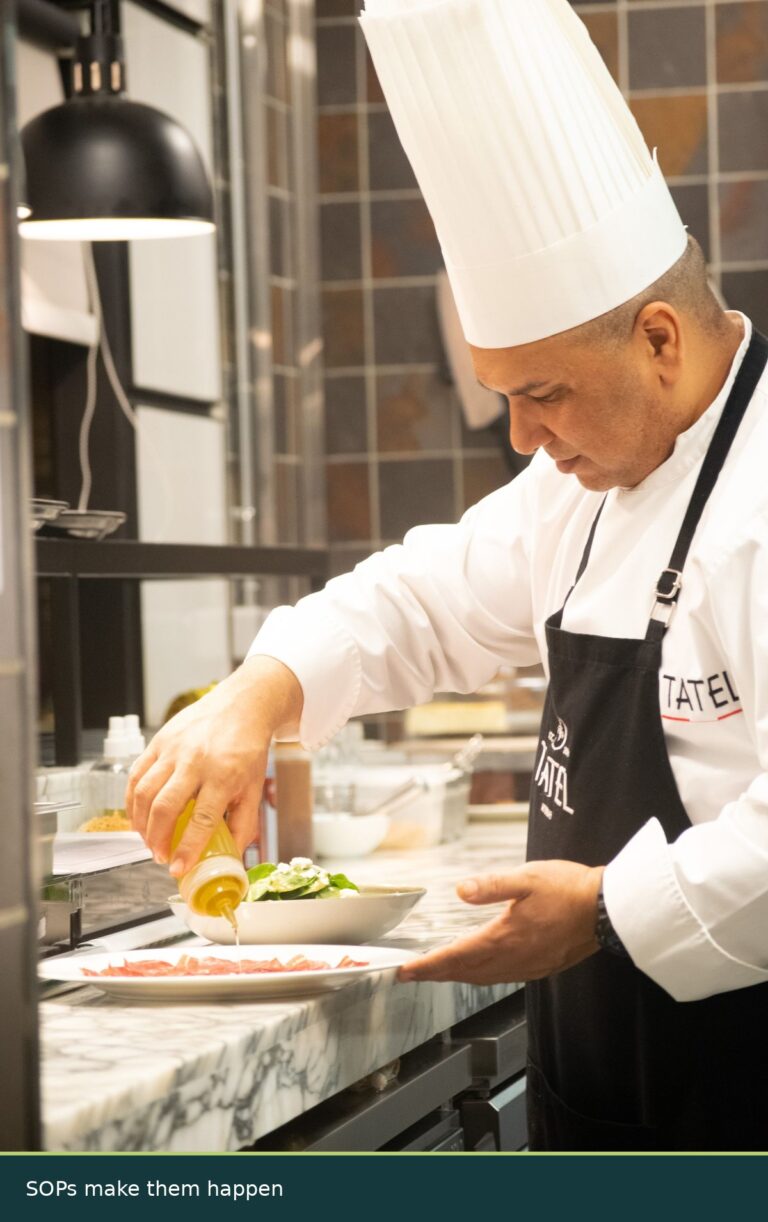
A Food Safety Management System and Allergen Policy are valuable foundations, but they only become meaningful when staff can implement them consistently. This is where Standard Operating Procedures (SOPs) become essential. An SOP should clearly explain how your business manages gluten-free preparation in practice. It should reflect what actually happens in your kitchen, café, bakery or foodservice operation – not simply what sounds good on paper. Staff should be able to answer practical questions such as:
- Which ingredients are approved?
- Where are gluten-free products stored?
- Which equipment is dedicated or controlled?
- How is cleaning completed before preparation?
- How is the order communicated to the kitchen?
- Who checks the meal before service?
Are there gateways to check along the way for each procedure?
Documenting these procedures forms part of your due diligence and provides consistency across different shifts and members of staff. As well as giving confidence to customers
Gluten free claims and other free-from claims are not the same
Another important area of confusion is assuming that all free-from claims operate under the same rules. They do not.
A Gluten free claim has a defined legal threshold of no more than 20ppm in the final food. Other allergen-related claims, such as nut free or milk free, currently do not have an equivalent 20ppm threshold. These claims carry different expectations and should never be treated as interchangeable with the gluten-free definition. Businesses should also understand the term “very low gluten“. Very low gluten refers to foods containing specified gluten-containing cereals that have been specially processed to reduce their gluten content to below 100ppm. It is not intended as a practical alternative wording for hospitality businesses preparing loose food. Knowing the claim, you are making is just as important as knowing the ingredients you are using.
Communication gives customers confidence
Excellent allergen management is not just about documentation – it is also about people.
Written allergen information is essential, but for customers with food hypersensitivities, a conversation is often equally important. A customer does not necessarily expect a business to promise an impossible zero-risk environment. What they want is accurate information about how their food is being prepared.
For example, a trained member of staff should feel confident saying:
“We use gluten-free ingredients for this dish and follow our documented gluten-free preparation procedures. We have controls in place to minimise cross-contact, including our preparation and cleaning processes, although gluten-containing foods are also handled within the kitchen.”
That provides meaningful information. It allows the customer to ask further questions and decide whether they are comfortable eating at your venue. Compare that with responses such as: “It should be fine.” or “We can’t guarantee anything.” Neither gives the customer useful information about the controls your business actually has in place. Confidence comes from clear communication supported by genuine procedures.
Training is not the same as competency
Completing an allergen training course is important, but attendance alone does not guarantee competency. During a busy service, staff need to know:
- Where the current allergen information is kept
- Who is responsible for checking information
- How orders are communicated between front and back of house
- When they should stop and ask rather than guess
- How to explain procedures accurately to customers
The weakest link in the customer journey can undo even the strongest allergen policy. From booking through to arrival, ordering, kitchen preparation and service, everyone involved has a role in protecting the customer.
Five questions every Food Business should ask
Before making gluten-free claims on menus or labels, ask yourself:
- Is our Food Safety Management System specific to what we actually do?
- Does our Allergen Policy cover the complete customer journey?
- Can our staff confidently explain and implement our procedures?
- Can we substantiate the claims we are making on menus and labels?
- Are we monitoring, reviewing and learning from near misses or incidents?
These questions often reveal whether a business has a living allergen management system or simply a collection of documents.
Conclusion
The hospitality industry does not need more confusing terminology. It needs greater confidence in using clear language, supported by robust procedures.
A gluten free claim is the legally defined term.
For Food Business Operators selling loose food, routine testing is not mandatory, but appropriate controls are essential to support the claim.
Those controls should be documented through effective SOPs, implemented by competent staff, monitored regularly and verified as part of your Food Safety Management System.
Most importantly, communicate with your customer. Explain your processes honestly and confidently. Tell them what you do to reduce the risk of cross-contact and answer their questions using accurate information rather than assumptions.
The goal is not to make guarantees that cannot be substantiated. The goal is to provide enough trustworthy information for every customer with a food hypersensitivity to make an informed decision about whether they choose to eat with you.
**Don’t just say it – document it, implement it and verify it.**
Protect the customer. Protect your staff. Protect your reputation.
Need support with allergen management?
Food Allergy Aware supports hospitality, catering, education and foodservice businesses with practical allergen management solutions including:
- Food Safety Management System reviews
- Internal and external Allergen Policies
- Standard Operating Procedures
- Allergen matrices and customer communication
- Staff allergen awareness and competency training
- Food Allergy Aware Certification
If you would like support reviewing your current gluten-free procedures or allergen management systems, please get in contact or book a 30 minute free chat by clicking here
To download the one-page fact sheet click here