
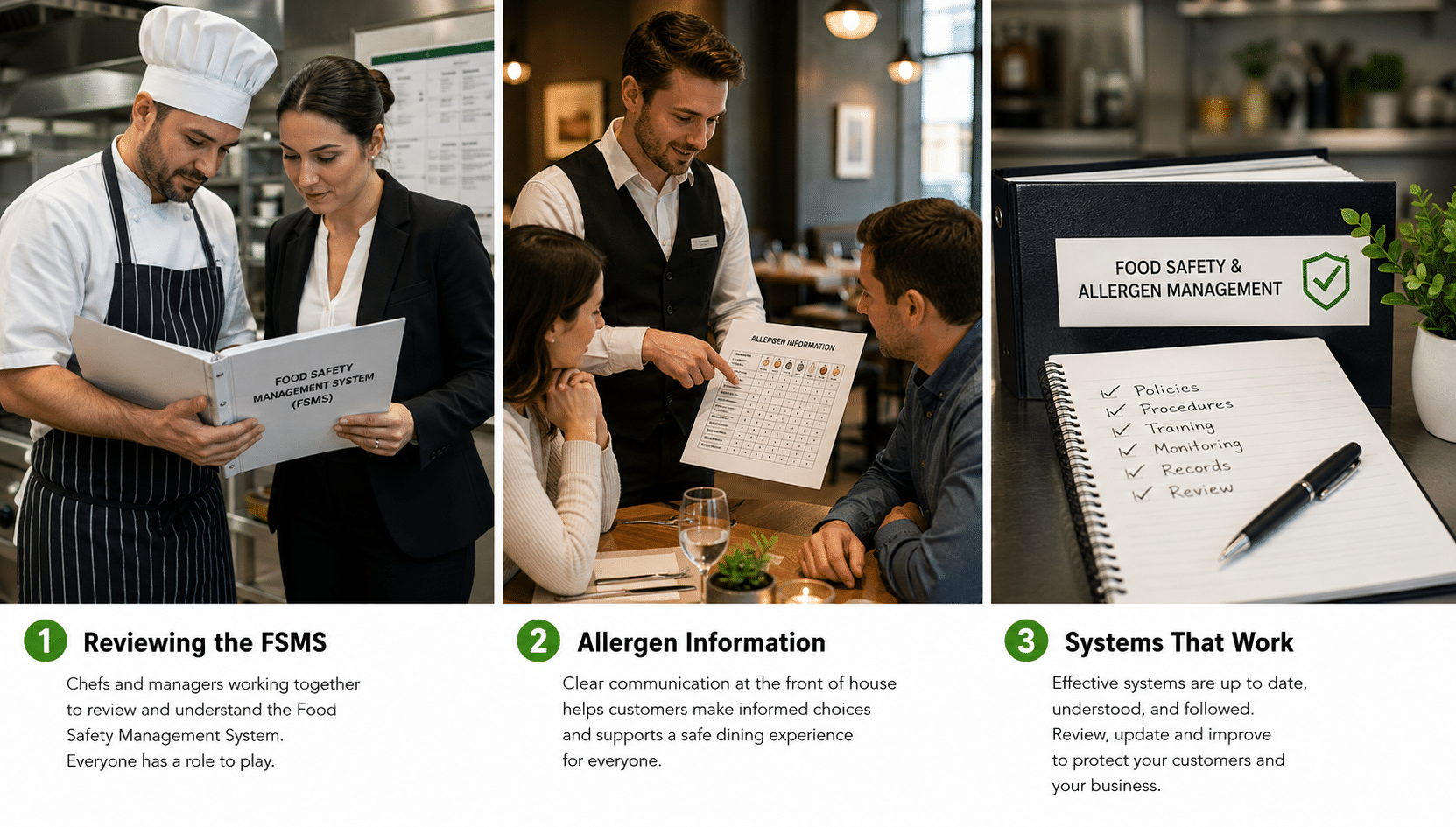
Your Food Safety Management System (FSMS) should be one of the most important working documents within your food business.
But when was the last time you actually looked at yours?
More importantly, does it accurately reflect what happens in your business today?
Over recent months, during Food Allergy Aware training delivered across the north and south of England, we have noticed a concerning recurring theme: some food safety management systems simply do not appear to be fit for the businesses using them.
Across several courses, we trained approximately 60 senior food & beverage and back-of-house staff. Around three-quarters were working with the same type of standard template – a document running to more than 260 pages.
When we asked how many had actually read their FSMS, either their appropriate sections or entirety only two people could honestly say they had.
More concerning was that many had barely looked at the HACCP documentation that should underpin the food safety procedures they are expected to follow either in the kitchen or serving the customer.
Often HACCP / SOPs are written by a manager or Health & Safety officer without the involvement of those in the kitchen or front of house carrying out the role. Good practice is to engage staff to understand their roles and self manage to prevent mistakes happening
That raises an important question:
Is your FSMS a working management system – or a tick-box exercise?
Having a comprehensive document on a shared drive or sitting in a folder does not necessarily mean you have an effective food safety management system.
A document is only valuable if it reflects the operation, is understood by the people responsible for implementing it and translates into what actually happens in the kitchen and across the wider food operation.
Ask yourself:
- Could your managers explain the relevant sections of your FSMS without having to search through hundreds of pages?
- Do your chefs understand the HACCP controls relevant to the processes they undertake?
- Do front-of-house teams understand where their responsibilities sit within allergen management?
And perhaps most importantly:
- Can you honestly say, hand on heart, that what is written in your FSMS reflects what actually happens in your business?
Your Documentation Is Part of Your Due Diligence
Food safety documentation should never exist simply because an auditor, EHO or company policy says that you need it.
Your procedures, monitoring and records may become extremely important evidence if something goes wrong.
If there is a serious food safety or allergen incident, it is not enough to demonstrate that you had a policy.
The questions are likely to go much further:
- What was your procedure?
- Was it appropriate for your operation?
- Were staff trained in it?
- Was it actually being followed?
- How did you monitor it?
- Can you demonstrate that your controls were effective?
This is why copying a generic template and filing it away can create a false sense of security
A 260-Page Manual Is Not Automatically a Good FSMS
Large food businesses can understandably require substantial documentation.
The issue is not simply the number of pages.
The issue is whether those pages are relevant, accessible, understood and implemented.
We have seen template systems containing procedures for activities that individual businesses simply do not undertake.
If your template includes sous vide or vacuum packing, for example, but you don’t carry out those processes, why is that procedure still sitting within your FSMS?
A template should be the starting point, not the finished product.
Every section should be considered:
Does this apply to us?
If yes, make sure it accurately describes your controls.
If no, remove it.
If something important to your operation is missing, add it.
The end result should describe your business, not the business the original template happened to be written for.
Where Does Allergen Management Fit?
This is another area where we regularly see missed opportunities.
In one substantial combined food safety and allergen management document we reviewed, “gluten-free” was mentioned once and coeliac disease once.
That does not necessarily mean a system is legally non-compliant, but it should prompt questions about whether allergen management has been given sufficient operational consideration.
Allergen management should not be an appendix added to the back of the FSMS.
Neither should an allergen matrix be mistaken for an allergen management policy.
Your FSMS and allergen management policy should work in synergy.
Allergen controls should connect with:
Supplier approval → purchasing → goods-in → storage → recipes → substitutions → preparation → cross-contact controls → cleaning → service → customer communication → incident management → review
If these areas sit in different documents, they still need to tell the same story.
If the allergen policy says one thing, the HACCP another and staff are doing something completely different, you potentially have a significant gap.

Make Food Safety Documentation Easier to Use
There can be benefits to moving away from one enormous document and creating a more structured, manageable system.
Your overarching Food Safety Policy can establish the organisation’s commitment and responsibilities, supported by clearly identified sections or individual policies covering areas such as:
HACCP | Allergen Management | Supplier Approval | Cleaning | Personal Hygiene | Temperature Control | Cross-Contamination | Training | Traceability | Incident Management | Verification & Review
This makes information easier to find, understand, train and update.
Think of it as bite-sized food safety management.
The objective isn’t to reduce standards. It is to make those standards more usable.
Is SFBB Appropriate for a Large Organisation?
Safer Food, Better Business (SFBB) is a valuable HACCP-based food safety management system produced by the Food Standards Agency, and the FSA describes the catering pack as being developed for small catering businesses such as restaurants, cafés and takeaways.
We recently came across a higher education establishment serving a population of more than 5,000 students using SFBB as its food safety management system.
This immediately raises the question of proportionality.
As organisations become larger and their food operations more complex – multiple outlets, large teams, different food processes, vulnerable consumers, central purchasing, multiple suppliers and extensive allergen requirements – management should consider whether the system being used adequately represents and controls those risks.
The question isn’t whether you possess an FSMS.
The question is:
Is your FSMS appropriate for the size, complexity and risks of your operation?
A Recent University Review – Getting the Documentation to Reflect Reality
We recently supported a local university with a comprehensive review and update of its food safety management documentation.
It was a significant piece of work.
Why?
Because properly reviewing an FSMS isn’t a case of changing the date on the front page.
We needed to check processes, responsibilities, terminology, procedures and supporting documentation and make sure the system reflected the university’s current operation.
- It takes time.
- It takes conversations with the people actually doing the job.
- It requires checking what is written against what happens operationally.
- But that is precisely what a meaningful FSMS review should achieve.
When Did You Last Review Yours?
Food businesses change constantly.
Menus change. Suppliers change. Equipment changes. Teams change. Processes change. Technology changes. Legislation and industry guidance evolve.
Your FSMS and allergen management documentation need to keep pace.
So here is a simple challenge for your management team:
Take your FSMS off the shelf or open it on your system.
Pick five procedures at random and ask:
- Is this still accurate?
- Does it apply to our business?
- Do our managers know it exists?
- Are our teams actually following it?
- Can we evidence that it happens?
If you cannot confidently answer yes, your documentation may be due for a review.
Policy → Procedure → Training → Practice → Evidence
There should be a clear thread throughout your food safety and allergen management system:
- POLICY – What do we say we will do?
- PROCEDURE – How are we going to do it?
- TRAINING – Have we made sure our people understand it?
- PRACTICE – Is it actually happening?
- EVIDENCE – Can we prove it?
- REVIEW – Have we checked that it continues to work?
If any one of those links is missing, the system becomes weaker.
Could Food Allergy Aware Help?
If your food safety or allergen management documentation is due for review, this could also be an opportunity to look at the two together.
Food Allergy Aware can support businesses with reviewing and updating their FSMS and allergen management documentation, helping ensure policies and procedures better reflect the operation and are practical for the teams expected to use them.
For suitable businesses, this work can also be combined with working towards Food Allergy Aware Certification.
This can provide an opportunity to review existing documentation, strengthen allergen management, identify gaps and work towards independent recognition of the standards being achieved – potentially combining pieces of work rather than undertaking them separately.
So, one final question:
If something happened tomorrow, would you be confident putting your FSMS and allergen management policy on the table and saying:
“Yes. This accurately reflects what we do, our staff understand their responsibilities, and we can demonstrate that these controls are implemented.”
If the answer is anything other than a confident yes, it may be time for a review.
Food safety management isn’t about having the paperwork. It’s about making the paperwork work.